An international research consortium has been selected for the European Research Council (ERC) Synergy Grant program to investigate how the brain processes sensory information and controls movement in freely moving primates. Announced on November 6 by the Korea Advanced Institute of Science and Technology (KAIST, led by President Choongsik Bae), the six-year project, titled NeuroEthoPrim (“From Neuroethology to Restoring Sensorimotor Function via Stealth Neurotechnologies in Freely Moving Primates”), marks the first time a researcher affiliated with a South Korean university has been selected as a principal investigator under this European funding scheme. Co-principal investigator Professor Kyung-In Jang from KAIST’s Department of Mechanical Engineering will collaborate with corresponding principal investigator Professor Luca Bonini from the University of Parma in Italy and co-lead Professor Silvestro Micera, who holds joint appointments at the Scuola Superiore Sant’Anna (SSSA) in Italy and the École Polytechnique Fédérale de Lausanne (EPFL) in Switzerland.
The collaborative initiative will receive approximately €9.68 million (approximately KRW 14.4 billion) over six years, with approximately €3.10 million (approximately KRW 4.6 billion) allocated to KAIST. As the European Union’s dedicated funding body for frontier research, the ERC awards Synergy Grants to groups of two to four principal investigators who pool complementary expertise to address ambitious scientific challenges that would be difficult for an individual researcher to tackle alone. Demonstrating the program’s scope, Synergy Grant funding previously supported BlackHoleCam, a collaborative project that contributed to capturing the first direct image of a black hole in 2019. Under the new grant, the researchers will focus their shared capabilities on understanding the neurobiological principles underlying motor control during unconstrained natural behaviors.
NeuroEthoPrim specifically addresses how neural circuits process sensory feedback and translate it into motor commands during everyday actions, such as walking or touching an object. Conventional neuroscientific experiments typically secure an animal’s head in a fixed position while requiring it to perform repetitive, prescribed movements. Although this established approach permits precise measurement of brain signals, it offers limited insight into the complex, multi-dimensional movements that characterize natural life. To move beyond these experimental constraints, the research team will monitor neural dynamics while non-human primates move about freely, bridging the gap between constrained laboratory protocols and the rich behavioral repertoire of unrestrained subjects.
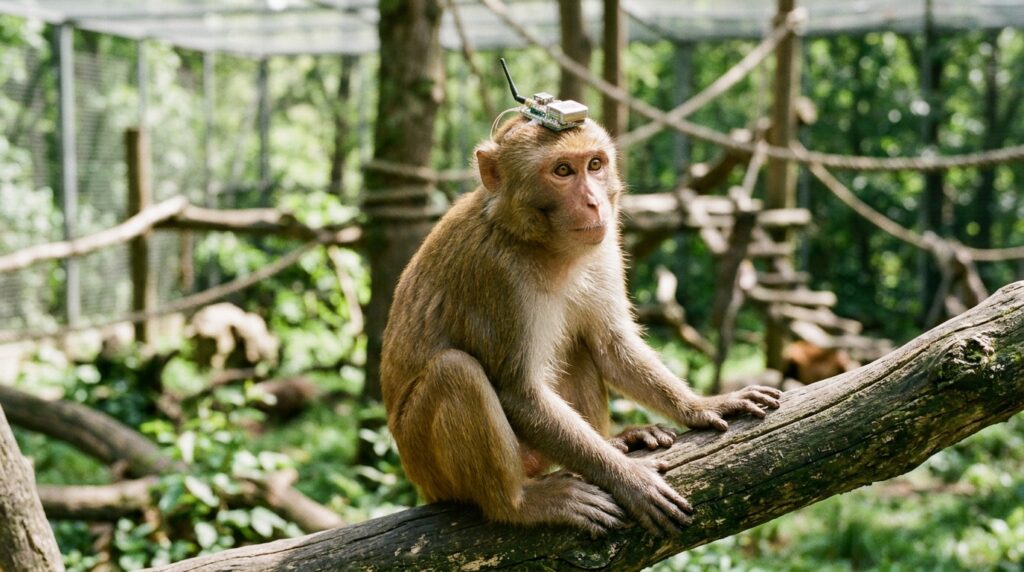
To execute this work, the consortium will utilize the NeuroEthoRoom, a specialized experimental environment where monkeys can walk freely, explore, and search for food. Within this facility, investigators will simultaneously record intracortical brain activity, whole-body movements, and tactile sensory information. By analyzing these synchronized data streams, the researchers aim to determine how the brain translates what animals see and feel into coordinated bodily actions. The study will examine neural communication in both directions: decoding, which analyzes brain signals to infer movement intention, and encoding, which converts external sensory information into neural signals the brain can process. This bidirectional framework will track how movement commands are generated and how sensory feedback is received.
The collected physiological and behavioral data will subsequently be used to construct a computational foundation model, an artificial intelligence system that learns the relationships between diverse sensory inputs and body movements. By analyzing these integrated datasets, the researchers intend to identify common governing principles that regulate biological movement. Professor Jang will lead the development of implantable wireless neural interfaces designed to record brain signals and deliver electrical stimulation. A central engineering objective for his team is reducing the physical mismatch between soft brain tissue and rigid semiconductor materials. Overcoming this mechanical discrepancy is essential for maintaining stable, long-term signal recordings in unrestrained animals and delivering precise stimulation to targeted brain regions as needed.
Professor Jang’s team plans to apply the project’s findings toward developing ALEX, a next-generation brain chip, and LUCAS, an operating system engineered to help individuals with neurological disorders control external devices. The researchers will also pursue commercialization through ENSIDE, a faculty-founded startup company. In the long term, the team aims to build upon these core neurotechnologies to create a Brain-to-X platform enabling patients with quadriplegia to command devices such as smartphones and wheelchairs using their brain signals. However, applying these technologies to human clinical care represents a long-term goal that will require extensive further research, as well as comprehensive validation of clinical safety and therapeutic efficacy.
“The starting point for this research is to understand how the brain links sensation and movement when we move freely,” stated Professor Jang, emphasizing that the consortium will make every effort to ensure that insights from this basic research ultimately help patients with nervous system injuries return to everyday life. Because the investigation involves non-human primates, all animal experiments within the NeuroEthoPrim project will comply strictly with the European Union Directive on the protection of animals used for scientific purposes (Directive 2010/63/EU). In addition, every experimental procedure will be conducted only after securing formal review and prospective approval from the Institutional Animal Care and Use Committee (IACUC) at each participating institution.
Subject of Research: Neural mechanisms of sensorimotor control and wireless neural interfaces in freely moving primates
Article Title: KAIST professor Kyung-In Jang selected for ERC Synergy Grant to study how the brain controls movement in freely moving monkeys
Article References: KAIST professor Kyung-In Jang selected for ERC Synergy Grant to study how the brain controls movement in freely moving monkeys. Original publication (Bibliographic details unavailable.)
Image Credits: AI Generated
DOI: Not provided
Keywords: neuroscience, sensorimotor control, ERC Synergy Grant, KAIST, neural interfaces, primates, brain activity, neurotechnology, professor, Kyung-In, Jang, selected