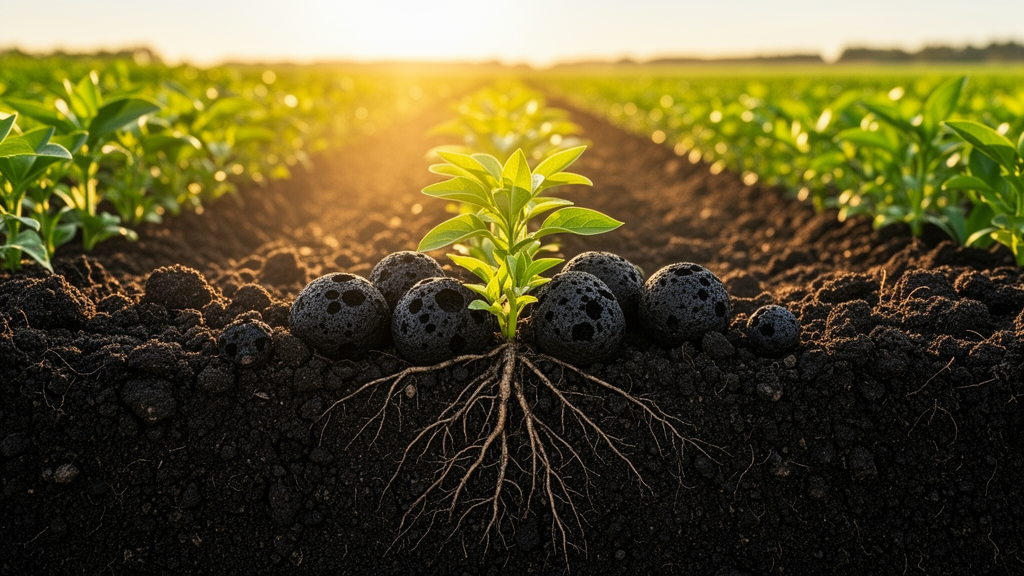
A global meta-analysis of 2,079 paired observations from 32 peer-reviewed publications reveals that warming significantly increases carbon dioxide emissions in biochar-amended soils. The study, published in the journal Biochar, quantifies the response of soil carbon emissions to rising temperatures and identifies the key drivers behind these changes. Overall, warming increased CO2 emissions in biochar-amended soils by 77% on average. This finding suggests that the climate mitigation potential of biochar may be overestimated if the warming-induced carbon losses are ignored in soil carbon management frameworks.
The research team conducted the meta-analysis to address a critical gap in understanding how biochar-amended soils respond to a warming climate. While biochar application is recognized as a promising strategy for enhancing soil carbon sequestration, its influence on CO2 emissions under warming conditions remained inadequately understood. The study aimed to quantify the impact of warming on CO2 emissions across cropland and forest ecosystems and assess the relative importance of warming intensity, biochar characteristics, and soil properties in regulating these responses.
The data collection process followed the Preferred Reporting Items for Systematic Reviews and Meta-Analyses statement. The researchers searched peer-reviewed literature published up to October 28, 2025, in the Web of Science, Scopus, and CNKI databases. From an initial pool of 2,261 articles, they screened 187 based on title and abstract, and finally included 32 articles that met specific inclusion criteria. These criteria required concurrent high and low temperature settings, terrestrial soils, and clearly reported biochar application rates and pyrolysis temperatures.
The results showed a distinct variation in warming effects across different land uses. Croplands exhibited a 117.5% increase in CO2 emissions, which is 3.8 times higher than the 30.9% increase observed in forests. This disparity indicates that land use-specific biochar application strategies should be considered in soil carbon management practice. The vulnerability of soil organic carbon in agricultural soils is greater compared to natural forest ecosystems, likely due to management practices like tillage that weaken physical protection of carbon.
Biochar characteristics also modulated the warming-induced CO2 emissions. The effect was strongest for woody biochars, intermediate for crop-derived biochars, and weakest for grass-derived biochars. Woody biochar-amended soils showed a stronger warming response in all ecosystems. This finding supports the carbon quality–temperature hypothesis, which posits that more refractory components require higher activation energy and therefore have greater temperature sensitivity than labile components.
The warming effect was positively correlated with pyrolysis temperature and the application rate of biochar in both cropland and forest soils. However, the relationship with the carbon-to-nitrogen ratio of biochar varied by ecosystem. In croplands, the warming-induced change in CO2 emissions was positively correlated with the biochar C/N ratio, while in forest soils, it decreased with the C/N ratio. These interactions highlight the complex role of biochar properties in determining soil carbon stability under warming.
Soil properties also played a significant role in shaping the warming effect. The warming effect on CO2 emissions increased with soil organic carbon, total nitrogen, soil C/N ratio, pH, and clay content across all ecosystems. In croplands, the warming effect was positively related to soil organic carbon, total nitrogen, pH, and clay content, but had no relationship with the soil C/N ratio. In forest soils, the warming effect increased with soil C/N ratio, pH, and clay content, while not varying with soil organic carbon and total nitrogen.
Warming magnitude was identified as the dominant driver of the warming effect on CO2 emissions, surpassing both soil properties and biochar characteristics across all ecosystems. The relative importance of variables in croplands was warming magnitude, followed by biochar application rate, biochar C/N ratio, clay content, pyrolysis temperature, soil pH, and soil organic carbon. In forests, the order was warming magnitude, biochar application rate, soil C/N ratio, soil organic carbon, pyrolysis temperature, and biochar C/N ratio.
The study also examined the role of biochar particle size. Biochar with smaller particles induced a larger increase in the warming effect compared to larger particles. Smaller particles create stronger responses due to larger surface area, which offers more sites for microbial colonization. Increased exposure of reactive sites accelerates substrate hydrolysis and carbon mineralization, making smaller biochar particles more efficient hotspots for microbial growth and CO2 production.
Publication bias was evaluated using Rosenthal’s fail-safe number and the trim-and-fill method. The fail-safe number for the warming effect was 142,911,954, indicating the statistical robustness of the result. The trim-and-fill model analysis indicated that the results remained robust against missing values of CO2 emission rates, ruling out the influence of publication bias. These tests suggest that publication bias did not pose a significant concern for the study’s findings.
The study has several limitations. Data coverage is sparse in tropical and polar ecosystems, arid and semi-arid zones, and high-latitude tundra. The observations are predominantly concentrated in temperate regions of China and Europe, which may reduce the universality and external validity of the research conclusions. Most observations are from laboratory studies, where the magnitudes of experimental warming are usually extreme, differing from real-world conditions. Future research should focus on field warming experiments with reasonable temperature gradients to further assess the responses of CO2 emissions from biochar-amended soils to warming.
To enhance the resilience of biochar applications, the researchers recommend context-specific strategies. These include prioritizing non-woody feedstocks, lower pyrolysis temperatures, and moderate application rates, particularly in vulnerable cropland systems. Integrating warming effects into biochar life-cycle assessments and soil carbon management frameworks is necessary to ensure realistic projections of biochar’s role in climate mitigation and carbon sequestration. Such targeted strategies will help align biochar use with projected warming impacts, increasing its effectiveness as a tool for sustainable soil management.
The meta-analysis drew on 2,079 paired observational data points extracted from 32 peer-reviewed publications, following a rigorous screening process that began with an initial pool of 2,261 articles. The literature search covered the Web of Science, Scopus, and CNKI databases up to October 28, 2025. Inclusion criteria required studies to feature concurrent high and low temperature settings for evaluating carbon dioxide emissions, conducted on terrestrial soils such as croplands, forests, or grasslands. Researchers also required that exact biochar application rates and pyrolysis temperatures be clearly reported, along with key initial soil properties like pH and soil organic carbon content. Both laboratory incubations and field warming experiments were included if they met these specific methodological standards, ensuring a diverse but controlled dataset for analysis.
To standardize the data, biochar application rates were converted to a common percentage unit from original values in tons per hectare, accounting for soil bulk density and application depth. When bulk density was not reported, default values were applied based on soil type, ranging from 1.5 t m−3 for sandy soil to 0.8 t m−3 for organic-rich soil. Biochar feedstocks were classified into woody materials from thinning or pruning, crop residues such as maize, rice, wheat, and mushrooms, and grasses like Miscanthus giganteus. Particle size was categorized into larger than 1 mm and smaller than 1 mm. This standardization allowed for consistent comparison across studies that originally used varying units and classification systems.
The statistical analysis assessed the warming effect using the natural log of the response ratio, calculated as the logarithm of the ratio between the means of the higher temperature treatment group and the lower temperature control group. This metric was transformed into a percentage change to enhance interpretability. To address the non-independence of multiple observations from a single study, the mean effect size was estimated using a random-effects model, with weighting factors based on within-study and between-study variance. Confidence intervals were derived from 999 bootstrap iterations. A weighted random forest model was employed to identify the relative importance of various variables influencing the warming effect, with all analyses performed in R version 4.3.3 using the metafor and randomForest packages.
The study found that the warming effect on carbon dioxide emissions increased with the magnitude of experimental warming across all ecosystems. In croplands, the response to warming was much faster than in forests, indicated by a greater slope in the relationship between warming magnitude and emission changes. This suggests that agricultural soils are more sensitive to temperature increases in terms of carbon release. The dominance of warming magnitude as a predictor underscores the critical role of temperature intensity in driving soil carbon feedbacks, surpassing the influence of specific biochar characteristics or soil properties in many scenarios.
Microbial mechanisms play a central role in these observed changes. Warming alters microbial species richness, community structure, and enzymatic diversity, which changes substrate accessibility in biochar-amended soils. Initially, microbes consume labile fractions of fresh biochar and soil organic carbon. However, as temperature rises and biochar ages, fungi may increase their degradation of more inert carbon in both biochar and soil, leading to higher carbon dioxide release. This process is consistent with the carbon quality–temperature hypothesis, which posits that more refractory components require higher activation energy and thus exhibit greater temperature sensitivity. The activation of warming-sensitive microbial phylotypes under stress further accelerates soil organic carbon decomposition.
Soil acidification may buffer warming-induced carbon dioxide emissions across ecosystems, as evidenced by a positive correlation between the warming effect and soil pH. In addition to physical protection effects, differences in substrate supply and microbial community structure are key influencing factors. Crop residues typically input a higher proportion of labile, readily decomposable carbon into soils compared to the recalcitrant lignin that dominates forest ecosystems. Long-term and frequent fertilization in farmland can elevate the relative abundance of copiotrophic bacteria, which display an extremely sensitive response to readily decomposable substrates under warming conditions. This amplifies the temperature sensitivity of soil organic carbon decomposition in agricultural settings.
The study highlights that the climate mitigation potential of biochar may be overestimated if warming-induced carbon losses are ignored. To address this, context-specific strategies are recommended, including the use of non-woody feedstocks, lower pyrolysis temperatures, and moderate application rates. These measures aim to reduce the reactivity of biochar and minimize the warming response of carbon dioxide release. Integrating warming effects into biochar life-cycle assessments and soil carbon management frameworks is essential for realistic projections of biochar’s role in climate mitigation. Such targeted approaches ensure that biochar use aligns with projected warming impacts, enhancing its effectiveness as a tool for sustainable soil management and climate resilience.
Subject of Research: Impact of warming on CO2 emissions in biochar-amended cropland and forest soils
Article Title: Warming increases CO2 emissions in biochar-amended cropland soil
Article References: Xu, T., Xu, Q., Lei, Y., Li, F., Kumar, A., Hui, D., Xue, J., Shan, S., Li, Y., Li, H., & Lin, J. (2026). Warming increases CO2 emissions in biochar-amended cropland soil. Biochar, 8(1), Article 106. https://doi.org/10.1007/s42773-026-00628-6
Image Credits: AI Generated
DOI: 10.1007/s42773-026-00628-6
Keywords: biochar, CO2 emissions, soil carbon, warming, cropland, meta-analysis, climate change, carbon sequestration, increases, emissions, biochar-amended, soil