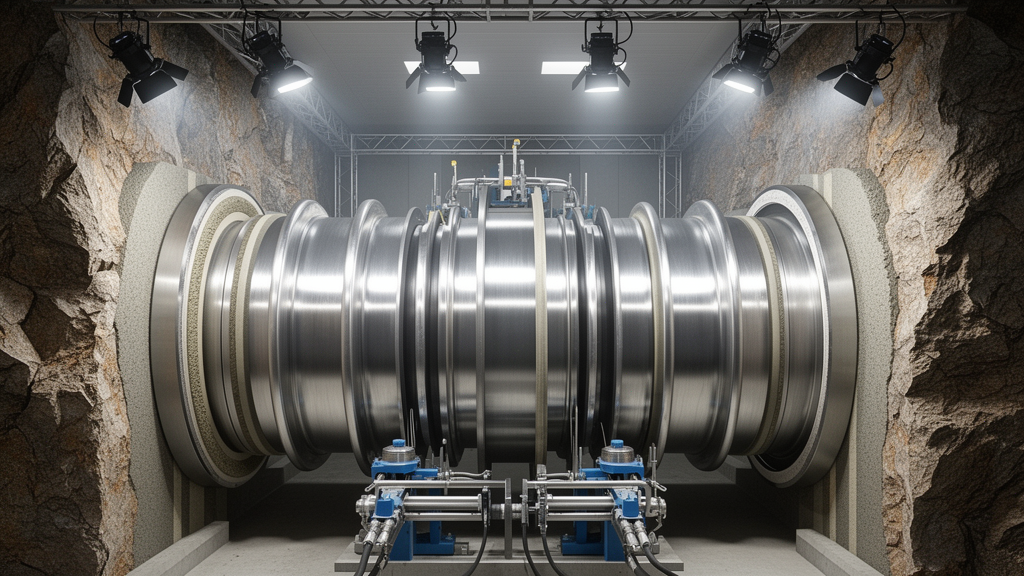
Researchers have provided the first full-scale experimental demonstration that localized casing expansion can restore zonal isolation across dual cemented annuli. The study, published in Geomechanics and Geophysics for Geo-Energy and Geo-Resources, addresses a critical challenge in subsurface engineering where cemented wellbore annuli become transmissive, compromising the long-term integrity of wells used for geothermal energy production, hydrogen storage, and carbon sequestration. While the localized casing expansion technique has previously shown effectiveness in single-annulus systems, its performance in more complex dual-annulus configurations remained uncertain. This new work evaluates the mechanism by which deformation of the inner casing is transmitted through nested annuli to affect the outer cement sheath, offering a potential scalable and rigless solution for multi-annulus well remediation.
The central research question focused on whether plastic deformation of the casing could effectively compress the annulus and close defects in the cement sheath when multiple layers of cement are present.
To evaluate this mechanism, the research team constructed two full-scale test vessels. The vessels were constructed with artificially induced microannuli. The induced defects were calibrated to yield an effective annulus permeability of approximately 0.1 Darcy.
The primary intervention involved the application of localized casing expansion using a Local Expander tool. The technology restores sealing by plastically deforming the casing, compressing the annulus, and closing defects in the cement sheath. In the initial phase of the experiments, standard LCE treatment was applied to the test vessels. The results indicated that this standard treatment was sufficient to eliminate detectable seepage in the inner annuli.
The data showed that the standard treatment reduced the permeability of the outer annuli by 97% to 99%.
To further enhance sealing performance, the researchers applied subsequent high-power LCE treatments. These treatments were applied under extended tool operating conditions. The high-power treatments resulted in further improvements to the sealing performance of the outer annuli. Specifically, the permeability of the outer annuli was reduced to the microdarcy range.
The findings indicate that load transfer through nested cement sheaths is sufficient to achieve meaningful sealing improvement. The study supports the characterization of LCE as a scalable, rigless solution for multi-annulus well remediation.
Subject of Research: Evaluation of localized casing expansion for restoring zonal isolation in dual cemented wellbore annuli
Article Title: Restoration of annular zonal isolation using localized casing expansion (LCE) technology: evaluation of Local Expander tool performance for treatment of dual cemented casing sections
Article References: Gardner, D., Lima, V. N., van Schie, C., Cornelissen, E. K., Keultjes, W. J. G., & Wolterbeek, T. K. T. (2026). Restoration of annular zonal isolation using localized casing expansion (LCE) technology: evaluation of Local Expander tool performance for treatment of dual cemented casing sections. Geomechanics and Geophysics for Geo-Energy and Geo-Resources. https://doi.org/10.1007/s40948-026-01230-7
Image Credits: AI Generated
DOI: 10.1007/s40948-026-01230-7
Keywords: localized casing expansion, zonal isolation, wellbore remediation, dual annulus, cement sheath, subsurface engineering, permeability reduction, geothermal energy, carbon sequestration, Restoration, annular, zonal