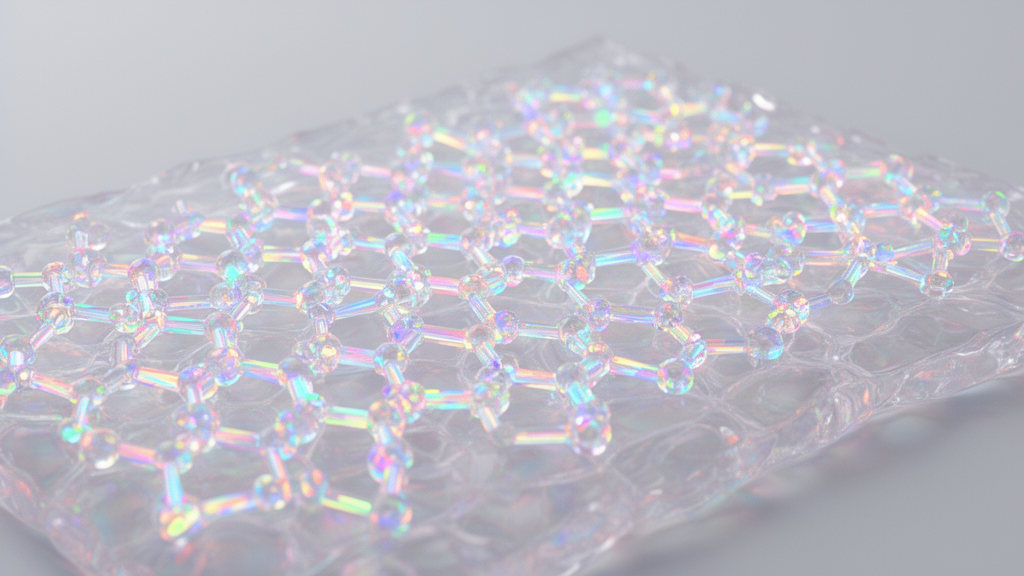
A research team has developed sustainable biopolymer composite films by incorporating a plant-derived cobalt-polyphenol coordination complex into a methylcellulose matrix, achieving near-theoretical crystallinity alongside major enhancements in linear and nonlinear optical behavior. The study explores an environmentally friendly, low-cost material platform designed to address the structural, optical, and photonic performance requirements of emerging flexible optoelectronic technologies.
To prepare the composite materials, the researchers synthesized a bio-derived coordination complex through the aqueous thermal extraction of polyphenols from rosemary (Rosmarinus officinalis), complexing the resulting phytochemical extracts with cobalt ions. This coordination complex was subsequently blended into methylcellulose films at varying concentration loadings using a solution-based processing method. The strategy represents a novel approach to tailoring biopolymer matrices, specifically focusing on how plant-derived coordination complexes alter native polymer bonding networks, modify optical band transitions, and influence theoretically calculated nonlinear optical parameters.
Chemical characterization using Fourier-transform infrared spectroscopy confirmed the successful chelate coordination between divalent cobalt cations and the oxygen-donor functional groups present on rosmarinic acid-like ligands. This chelation plays a decisive role in disrupting the native intramolecular and intermolecular hydrogen-bonding network inherently found in pure methylcellulose. In turn, the incorporation of the complex promotes the formation of new intermolecular interactions within the polymer matrix, producing an unprecedented quench time ranging from 15 to 20 seconds during the coordination process.
Structural investigations by X-ray diffraction demonstrated an extraordinary structural reordering in the composite films following complex doping. The diffraction measurements revealed a significant reduction in lattice microstrain alongside the formation of well-defined crystalline domains. As the complex loading reached an optimal level, the inter-chain d-spacing expanded from 9.78 angstroms in pure methylcellulose to 11.89 angstroms. Concurrently, the crystallinity index increased dramatically from a baseline of 29.80 percent in unmodified methylcellulose to 99.21 percent in the optimized composite, approaching near-theoretical crystallization limits.
This extensive structural reorganization produced substantial modifications in the optical properties of the films. The optical bandgap shifted from an insulating 5.97 electron-volts in pure methylcellulose down to 1.27 electron-volts in the composite films.
Optical dispersion analyses evaluated through the Wemple–DiDomenico single-oscillator and Drude–Lorentz models revealed that the static refractive index nearly doubled, reaching a value of 2.039. The dispersion modeling also identified a dramatic increase in free charge carrier density to 2.3394 × 10²⁷ per cubic meter, which in turn elevated the plasma frequency to 2.5347 × 10¹⁵ radians per second. Consequently, the optical sheet resistance decreased by several orders of magnitude to approximately 0.05 × 10⁻⁶ ohms per square, accompanied by a significant reduction in thermal emissivity.
The composite films also exhibited superior nonlinear optical characteristics. The authors concluded that incorporating rosemary-derived cobalt complexes provides an effective route for engineering functional biopolymer films, identifying them as potential candidates for optical filters, light-management coatings, and ultraviolet-shielding packaging, while noting that additional electrical, optical, electrochemical, and device-level testing remains necessary to evaluate transparent electrodes, nonlinear photonics, and energy-storage devices.
Subject of Research: Bio-derived cobalt-polyphenol methylcellulose composite films with tailored optical and structural properties
Article Title: Unlocking giant nonlinear optical response and near-theoretical crystallinity in bio-derived cobalt–methylcellulose films: eco-friendly biopolymer composites with tailored optoelectronic properties
Article References: Aziz, D. M., Mamand, D. M., Mohammed, H. A., Aziz, S. B., Amin, A. A. M., Hamasalih, G. H., Hussein, A. M., & Abdullah, R. M. (2026). Unlocking giant nonlinear optical response and near-theoretical crystallinity in bio-derived cobalt–methylcellulose films: eco-friendly biopolymer composites with tailored optoelectronic properties. BMC Chemistry. https://doi.org/10.1186/s13065-026-01959-y
Image Credits: AI Generated
DOI: 10.1186/s13065-026-01959-y
Keywords: methylcellulose, Rosmarinus officinalis, cobalt-polyphenol complex, chelate coordination, biopolymer composites, crystallinity index, optical bandgap modulation, x-ray diffraction, FTIR spectroscopy, Urbach energy, Wemple-DiDomenico model, Drude-Lorentz model, refractive index, plasma frequency, optical sheet resistance, third-order nonlinear susceptibility, nonlinear refractive index, UV-shielding packaging