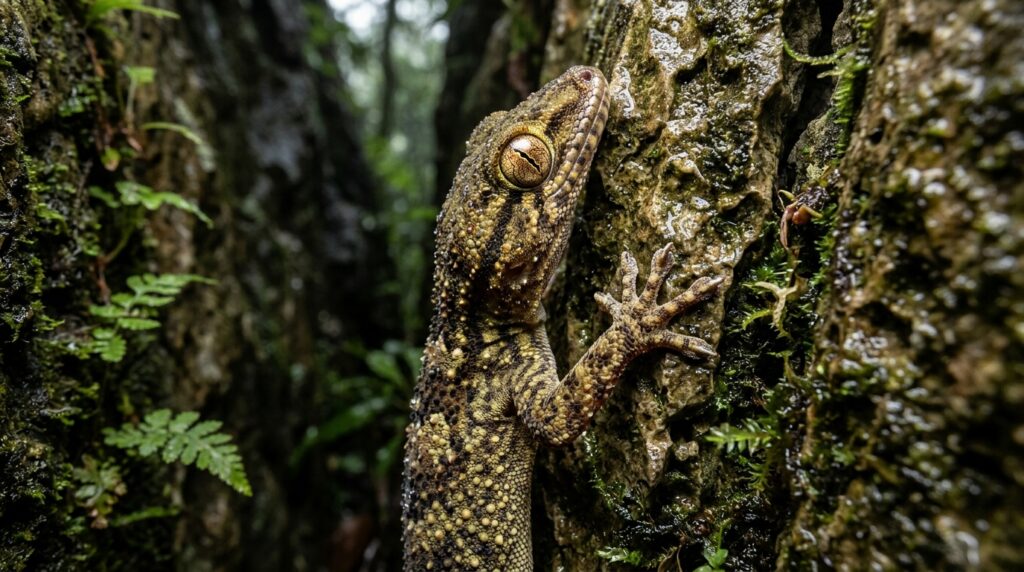
A bent-toed gecko radiation spread across the karst mountains of Laos, Vietnam, and Thailand has finally been mapped in full. A new molecular study reconstructs the family tree of the Cyrtodactylus angularis species group, a clade of at least 21 nominal bent-toed gecko species, and finds that it split into six evolutionarily independent lineages, each recovered with strong statistical support by multiple independent analyses. The work, published in Zoosystematics and Evolution, also traces when and where these lineages arose, pointing to the Oligocene for the group’s earliest origins and a burst of Miocene diversification that coincides with the rise of the East Asian summer monsoon.
Cyrtodactylus is by far the most speciose and ecologically diverse genus of the gecko family Gekkonidae. It currently contains 398 nominal species distributed from Tibet and tropical South Asia through Indochina, the Philippines, and the Indo-Australian Archipelago to the Solomon Islands, and only 70 species were known to science at the turn of this century. That makes it the third-largest vertebrate genus on Earth, and its diversity is still considered underestimated, with many undescribed forms awaiting formal names. Members of the genus occupy a striking range of habitats, from intertidal zones, caves, karst, granite, and swamps to coffee plantations, and earlier work documented dozens of habitat-preference shifts that helped the genus become one of the most successful vertebrate groups on the planet, with major radiations in Indochina, Sundaland, Wallacea, and the Philippines since the Eocene.
The C. angularis group is one of the most speciose Indochinese lineages within the genus, with at least 21 nominal species plus several undescribed forms. Although the type species was discovered in the early twentieth century, most of the group’s diversity remained unrecognized until the early twenty-first century. A large portion of these geckos is tied to karst, a special ecotype shaped by dissolving limestone. Their color patterns are equally varied, including dorsal blotches in C. teyniei, irregular separate spots in C. multiporus, and bands in C. bansocensis and C. darevskii. Most species are geographically restricted and known only from their type localities: C. angularis and C. chanhomeae in Thailand; fourteen species in Laos; C. hangvaensis, C. nigriocularis, and C. phongnhakebangensis in Vietnam; C. jarujini in Laos and Thailand; and C. roesleri in Laos and Vietnam.
Aside from the two Thai-only species, all members except the Black-eyed Bent-toed Gecko, C. nigriocularis, occupy the northern Annamite Mountain Range, which extends across the Laos–Vietnam border and is famous for its endemism and evolutionary distinctiveness. On the Vietnamese side, the northern Annamites harbor 115 reptile species, roughly 24 percent of the country’s reptile diversity, including 12 endemic species, despite a relatively small geographic extent. The landscape also shelters Critically Endangered vertebrates such as the Saola, the Large-antlered Muntjac, the Southern White-cheeked Gibbon, and Edwards’s Pheasant, along with microendemic karst mammals like the Laotian Rock Rat, often considered a living fossil because its Asian relatives went extinct approximately 11 million years ago. Little research had previously addressed the tempo and mode of evolutionary processes driving species radiations in the karst habitats of the Annamites.
To close that gap, the researchers analyzed data from three mitochondrial loci, COI, Cytb, and ND2 including tRNA, and four nuclear loci, Cmos, PDC, Rag1, and Rpl35, for all recognized taxa of the group. In total, 36 samples representing the 21 described taxa plus one undescribed taxon were included, alongside four outgroup species. The study generated 199 new sequences spanning the seven genes and added 68 previously published sequences, making the combined matrix the largest molecular dataset assembled for the species group to date in both the number of loci and the length of the concatenated alignment. Phylogenetic relationships were estimated with maximum likelihood, Bayesian inference, and maximum parsimony, and genetic divergences between members were calculated as uncorrected p-distances.
The combined dataset consisted of 5,275 aligned characters, of which 3,534 were constant, 314 were variable and parsimony-uninformative, and 1,427 were parsimony-informative. The mitochondrial matrix comprised 2,935 positions and the nuclear matrix 2,340 characters. For the first time, the analyses recovered six strongly supported subgroups within the species group, with high confidence across at least three independent analyses, except for the maximum parsimony result for Group III. C. nigriocularis emerged as the sister species to all other members. Group I is restricted to Ba Den Mountain in southern Vietnam, Group II contains the two eastern Thai species, and Groups III through VI occur almost exclusively in the northern Annamites: Group III holds two species from northern Laos, Group IV occupies central Vietnam and eastern Laos, Group V stretches from eastern Thailand to central and northern Laos, and Group VI ranges from central Laos to north-central Vietnam. Within the groups, the lowest and highest pairwise COI divergences ranged from 3.65 percent between C. darevskii and C. hinnamnoensis to 21.01 percent between C. khammouanensis and C. muangfuangensis, with Cytb values from 3.10 to 22.41 percent and ND2 values from 2.31 to 22.99 percent.
Combining mitochondrial and nuclear data markedly improved statistical support at deeper nodes compared with mitochondrial data alone, reflecting the slower rate of evolution of the nuclear markers. This pattern helps explain why earlier studies, which relied primarily on one or two mitochondrial genes and sparser taxon sampling, could not fully resolve the group’s relationships. The new results also diverge from some prior work: C. pageli is placed as sister to C. muangfuangensis in Group III, whereas earlier analyses had suggested it clusters with the Thai Group II species. The current taxonomy still underestimates the group’s diversity, the study concludes, with at least six populations, two from Thailand and four from Laos, flagged as potential new species across the three studies, and genetically distinct lineages detected within C. darevskii, C. hinnamnoensis, C. pageli, and C. sommerladi. Nuclear-only analyses even suggested that several species are paraphyletic or polyphyletic, a signal the authors attribute to incomplete lineage sorting or historical gene flow, and they recommend genome-wide SNPs and microsatellites to resolve the remaining shallow nodes.
Divergence dating with a Bayesian relaxed-clock approach, calibrated with secondary calibrations because no valid fossils exist for the lineage, placed the origin of the group in the Oligocene. C. nigriocularis diverged from the other members approximately 29.46 to 35.48 million years ago, and Group II, Group III, and the clade comprising Groups IV through VI began to emerge in the Oligocene as well, with the two Group II species splitting in the late Oligocene. The remaining lineages diverged during the Miocene, between 23.03 and 5.3 million years ago, and the most recent speciation event, the split between C. hinnamnoensis and C. darevskii, occurred in the Pleistocene approximately 2.06 million years ago. Several other species, including C. calamei, C. jaegeri, C. jarujini, C. roesleri, C. soudthichaki, C. sommerladi, and C. thathomensis, are the youngest members, starting to speciate from the early Pliocene around 4.8 to 2.75 million years ago. The authors note that secondary calibrations carry an inherent risk of propagating estimation errors.
Biogeographic reconstructions using Bayesian binary MCMC in RASP assigned the group’s distributions to three areas of endemism: the northern Annamites, the Mekong Lowland, and West Indochina. The Mekong Lowland received the highest probability, 73.67 percent, as the ancestral area of the entire group, followed by West Indochina at 12.55 percent and the northern Annamites at 10.91 percent. West Indochina was the most probable ancestral area for Group II at 99.35 percent, while the northern Annamites were recovered as the most probable ancestral area for Groups III, IV, V, and VI at 99.85 percent or higher. The group likely colonized West Indochina and the Annamites during the late Oligocene, and the common ancestors of Groups II through VI, representing 65 percent of the nodes within the species group, emerged in the Miocene. A complementary BioGeoBEARS analysis identified the DIVALIKE model as the best fit to the data, though its time-calibrated reconstruction did not provide informative results for the group.
The timing of this diversification corresponds remarkably well to the development of the East Asian summer monsoon around the Oligocene–Miocene boundary. Increased monsoon precipitation likely accelerated the dissolution of limestone substrates and reshaped the karst landscape, and the formation of open habitats within newly developed evergreen broadleaf forests may have facilitated range expansion and diversification, especially in the northern Annamites. Assuming that the granite-cave habitat preference of C. nigriocularis represents the ancestral state, the group may have transitioned to karst specialization early in its history, though the authors stress this scenario remains hypothetical and requires formal ancestral state reconstruction testing. The Miocene was also a formative epoch for other Annamite endemics, including a cavernicolous scorpion genus around 18 million years ago, Saola roughly 16 to 12 million years ago, and the Laotian rock rat around 7 million years ago. As favorable rainy conditions and vegetation cover shifted approximately 4 million years ago, diversification within the gecko group declined, yet the central Annamites still receive higher rainfall and remain dominated by evergreen forests, conditions that may help sustain ongoing evolutionary processes. The study adds to growing evidence that this global biodiversity hotspot maintains unique and evolutionarily distinct fauna, and it underscores how much of the region’s karst diversity still awaits discovery.
Subject of Research: Molecular phylogeny and biogeographic history of the Cyrtodactylus angularis bent-toed gecko species group in Indochina
Article Title: Molecular phylogeny and biogeography of the Cyrtodactylus angularis group: diversification in a global biodiversity hotspot
Article References: Ngo, H. T., Pham, N. D., Ho, A. T. N., Luu, V. Q., Nguyen, V. T. H., Nguyen, T. Q., Pham, C. T., Grismer, L. L., Ziegler, T., & Le, M. D. (2026). Molecular phylogeny and biogeography of the Cyrtodactylus angularis group: diversification in a global biodiversity hotspot. Zoosystematics and Evolution, 102(6), 1329-1343. https://doi.org/10.3897/zse.102.189560
Image Credits: AI Generated
Keywords: Cyrtodactylus angularis group, bent-toed geckos, molecular phylogeny, Annamite Mountains, karst biodiversity, Mekong Lowland, East Asian summer monsoon, divergence dating, biogeography, Indochina, species diversification, Gekkonidae