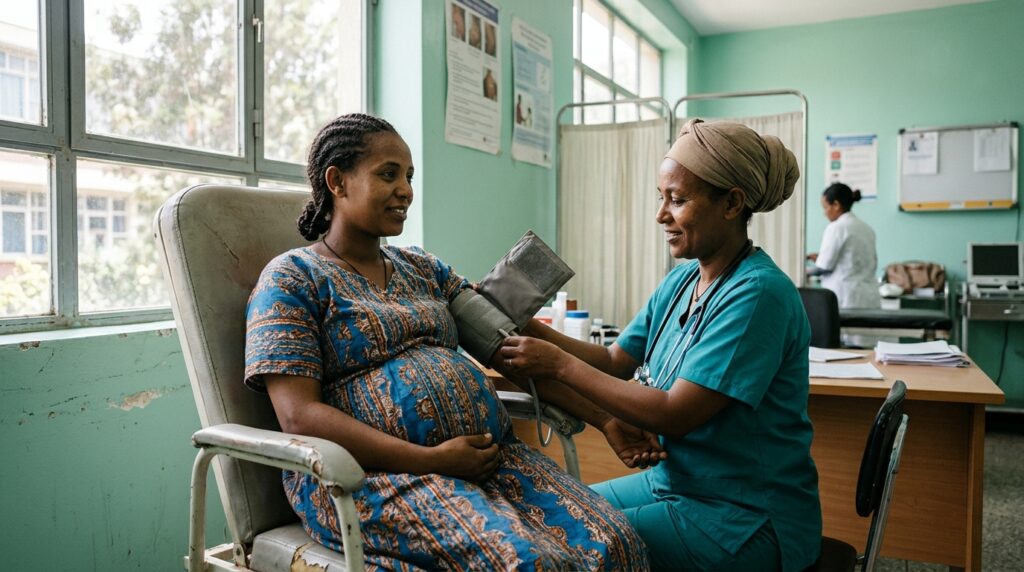
More than four in ten pregnant women attending antenatal care at Dilla University Referral Hospital in Ethiopia had blood pressure above the normal range, according to a hospital-based cross-sectional study published in BMC Pregnancy and Childbirth. Of the 204 pregnant women studied, 116 (56.86%) had normal blood pressure, 36 (17.65%) had elevated blood pressure, 32 (15.69%) had stage I hypertension, and 20 (9.80%) had stage II hypertension, meaning 43.14% fell into one of the three raised categories.
The study was conducted from November 2023 to October 2024 and applied the 2017 AHA/ACC guidelines to categorise blood pressure as normal, elevated, stage I hypertension, or stage II hypertension. Pregnant women with chronic hypertension and those with fewer than four blood pressure readings were excluded from the sample. The researchers analysed the data using descriptive statistics and an ordinal logistic regression model, and verified the parallel line assumption with the Brant test. The proportional odds assumption was satisfied, and significant factors for high blood pressure were then identified using the proportional odds model. The association between each explanatory variable and a single blood pressure level category was presented using the marginal effect.
Several factors were significantly associated with blood pressure category. These included HIV status (OR = 0.20; p-value = 0.001), parity above 5 (OR = 13.4; p-value = 0.001), multiple pregnancy (OR = 3.94; p-value = 0.008), mother’s age (OR = 5.9; p-value = 0.001), family size greater than 5 (OR = 12.5; p-value = 0.001), and iron taking status (OR = 0.26; p-value = 0.001). The direction of these associations differed across factors: older age, larger family size, multiple pregnancies, and higher parity increased the likelihood of high blood pressure, while iron supplementation and higher educational level decreased that likelihood. The odds ratios for HIV status and iron taking status were below one, indicating a negative association with blood pressure category in this sample.
The authors note that high blood pressure during pregnancy can lead to preterm birth and preeclampsia, among other issues for both the mother and the fetus, and that these risks are particularly relevant in low- and middle-income countries including Ethiopia. The study’s conclusions state that high blood pressure remains a major public health concern among pregnant women attending antenatal care visits at Dilla University Referral Hospital. The authors suggest that promoting maternal education and iron supplementation, and providing closer monitoring for high-risk mothers, may perhaps help reduce hypertension-associated complications during pregnancy.
As a cross-sectional study of 204 women at a single referral hospital, the findings describe associations at one point in care rather than causal effects, and the results may not generalise to pregnant women in other settings. The authors also note that the article is being shared early to provide faster access to peer-reviewed, accepted research; this version is subject to further edits and will be replaced by the final Version of Record.
Subject of Research: Factors associated with high blood pressure among pregnant women attending antenatal care at an Ethiopian referral hospital
Article Title: High blood pressure and associated factors among pregnant women attending antenatal care (ANC) visits at Dilla University Referral Hospital, Ethiopia: a cross-sectional study
Article References: Metkie, K. A., Ebrahim, F., Berhanu, G., & Hantal, H. S. (2026). High blood pressure and associated factors among pregnant women attending antenatal care (ANC) visits at Dilla University Referral Hospital, Ethiopia: a cross-sectional study. BMC Pregnancy and Childbirth. https://doi.org/10.1186/s12884-026-10231-z
Image Credits: AI Generated
DOI: 10.1186/s12884-026-10231-z
Keywords: hypertension, pregnancy, antenatal care, Ethiopia, cross-sectional study, blood pressure, preeclampsia, maternal health, iron supplementation, ordinal logistic regression, Dilla University Referral Hospital, High