
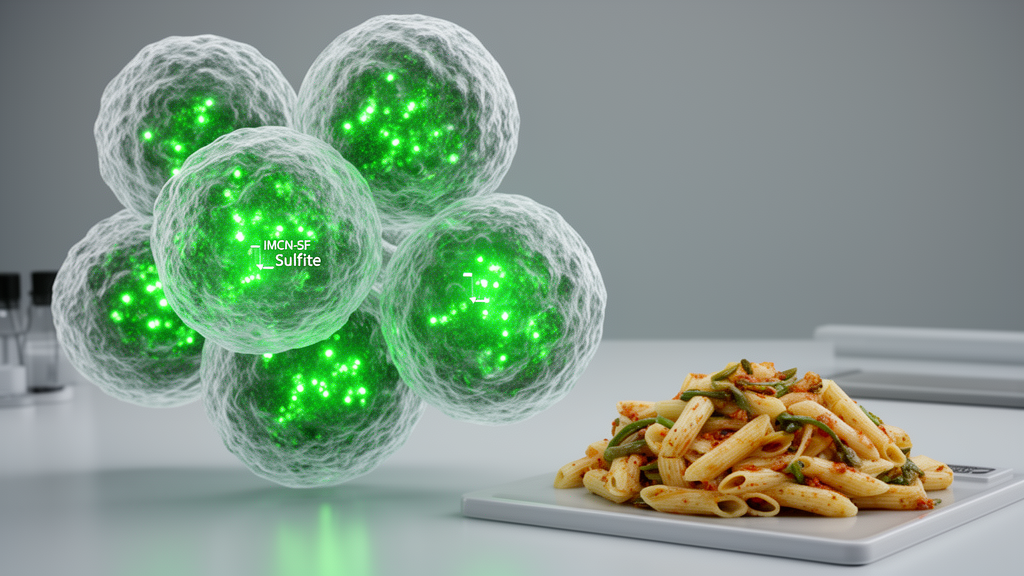
Researchers have introduced a fluorescent probe designated as IMCN-SF for the selective detection of sulfite in digested food samples and living pulmonary cells.
The molecular design of IMCN-SF integrates imidazo[1,5-a]pyridine and dicyanovinyl functional moieties to serve as the responsive chemical core. Upon encountering sulfite in test environments, the probe responds by reporting a strong fluorescence signal at 485 nanometers under light excitation at 365 nanometers, establishing a distinct optical readout for target analyte identification.
Performance assessments revealed several operational benefits for the newly developed probe during analytical testing. IMCN-SF displayed a rapid response upon exposure to sulfite, coupled with steady detection capabilities across a wide range of working conditions. Laboratory testing further confirmed that the compound exhibits both high sensitivity and high selectivity when identifying sulfite.
The researchers verified the practical utility of the probe by assessing the recovery of sulfite levels in food sample digested solutions.
In addition to food safety applications, the investigation evaluated IMCN-SF in living biological specimens. The probe successfully achieved direct visualization of sulfite concentration variations within living pulmonary cells, enabling researchers to track intracellular fluctuations linked specifically to cytoplasm stress-related pathological processes.
Published in the Chemical Biology section of Frontiers in Chemistry, the study demonstrates a dual-purpose sensing system that bridges food chemistry and cellular analysis. By opening a window for the systemic detection of sulfite in both digested food solutions and living pulmonary cells, the authors present a unified fluorescent tool for pathological research and sample inspection.
Supervised by corresponding author Zhong-Quan Zhu from Affiliated Jinhua Hospital at Zhejiang University School of Medicine in Jinhua, China, the original research manuscript was received on 09 July 2026 and accepted on 23 October 2026. Explicit publication disclaimers establish that all reported claims represent solely the views of the authors rather than institutional endorsements, and evaluated products receive no guarantee from the publisher.
Subject of Research: Fluorescent probe for sulfite detection in food samples and pulmonary cells
Article Title: A fluorescent probe containing imidazo[1,5-a]pyridine and dicyanovinyl moieties for the detection of sulfite in food sample digested solutions and living pulmonary cells
Article References: Zhou, X., Zhang, L., Lao, Y., Zhou, B., & Zhu, Z. (2026). A fluorescent probe containing imidazo[1,5-a]pyridine and dicyanovinyl moieties for the detection of sulfite in food sample digested solutions and living pulmonary cells. Frontiers in Chemistry, 14, Article 1932726. https://doi.org/10.3389/fchem.2026.1932726
Image Credits: AI Generated
DOI: 10.3389/fchem.2026.1932726
Keywords: IMCN-SF, fluorescent probe, sulfite detection, imidazo[1,5-a]pyridine, dicyanovinyl moiety, food sample digested solutions, living pulmonary cells, cytoplasm stress, fluorescence signal, emission at 485 nm, excitation at 365 nm, chemical biology, Frontiers in Chemistry, sulfite concentration, cell imaging, pathological processes, recovery rate

