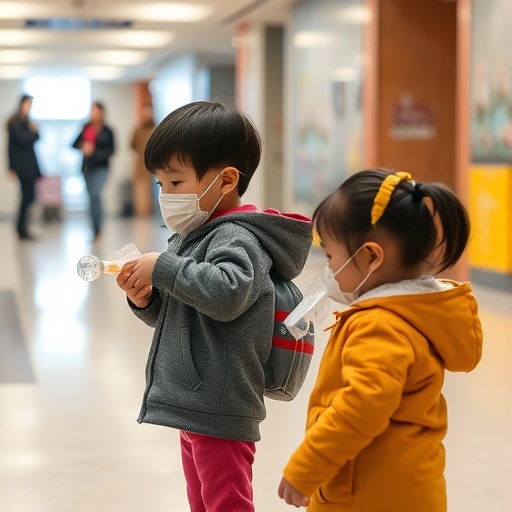
Phthalates, ubiquitous chemicals commonly found in numerous consumer and industrial products, have long been under scrutiny for their potential health impacts, particularly on vulnerable populations such as children. Recent research conducted in Tianjin, China, provides compelling evidence on how non-dietary indoor exposure pathways significantly contribute to the total phthalate intake in children, underscoring the hidden risks embedded within everyday indoor environments. These findings, published in the Journal of Exposure Science and Environmental Epidemiology, cast a spotlight on a dimension of chemical exposure that is both pervasive and previously underappreciated.
The study enrolled 324 children residing in Tianjin, a major urban center known for rapid industrialization and dense population. Researchers employed a comprehensive exposure assessment approach to quantify the variety of non-dietary indoor pathways contributing to phthalate intake. Unlike traditional models focusing predominantly on dietary ingestion as the principal source of phthalate exposure, this study illuminates the significant role played by inhalation, dermal absorption, and mouthing behaviors—especially in indoor settings where children spend the majority of their time.
Phthalates are primarily used as plasticizers, substances that increase flexibility in plastics such as polyvinyl chloride (PVC). These chemicals leach out of products like flooring, toys, personal care items, and household furnishings, contaminating indoor air and dust. Infants and young children are particularly susceptible to exposure through these media due to frequent hand-to-mouth contacts and proximity to floors where settled dust accumulates. The study thoroughly measured phthalate concentrations in air samples and dust collected from participants’ homes, linking these environmental loads to biomarkers of exposure found in children’s urine.
One of the critical findings was that indoor dust and air contributed to approximately 40-60% of the children’s total phthalate intake, a proportion higher than previously estimated in similar demographics elsewhere. This challenges the prevailing assumption that dietary intake dominates phthalate exposure and calls for a more nuanced evaluation of exposure pathways, disclosing the underestimated indoor environment’s role. The data highlight that the traditional exposure mitigation strategies, often centered on diet control, are insufficient to protect children adequately.
The methodological rigor of the study is exemplified by its use of advanced personal exposure monitoring techniques combined with biomonitoring. By integrating direct environmental sampling with urinary metabolite analysis, the researchers achieved a more accurate and individualized exposure profile. This dual-pronged approach accounts for inter-individual variability in behavior and environment, thus providing richer insights into exposure dynamics than could be gleaned from environmental measures alone.
Indoor air quality emerges as a pivotal factor in phthalate exposure. These volatile organic compounds (VOCs) emitted from various consumer products contribute to a complex indoor chemical milieu, sometimes referred to as “indoor chemical cocktails.” The Tianjin study revealed that phthalate concentrations in indoor air could be influenced by factors such as ventilation rates, temperature, and product usage patterns. These findings underscore the critical need to consider building characteristics and occupant behavior when assessing exposure risks.
Moreover, the research elucidated the significance of dermal absorption pathways, which are often overlooked in exposure assessments. Phthalates deposited on indoor surfaces or embedded in dust can transfer onto the skin, especially during physical contact with contaminated surfaces. Children’s skin, being more permeable than adults’, facilitates this uptake, effectively making direct contact with contaminated surfaces another route of exposure that cumulatively amplifies their total phthalate burden.
The study also discussed the health implications of chronic low-level phthalate exposure. Literature has linked phthalates to endocrine disruption, reproductive toxicity, neurodevelopmental deficits, and asthma exacerbation among children. Given that developing bodies are more sensitive to chemical perturbations, understanding these non-dietary pathways is vital for crafting public health interventions aimed at reducing early-life chemical burdens and their long-term ramifications.
Crucially, the study’s findings have regulatory and policy implications. Current safety standards and exposure guidelines typically focus on isolated exposure routes or single chemicals rather than the multifaceted character of indoor phthalate contamination. This research advocates for holistic exposure assessment frameworks that integrate multiple pathways and encourage controls tailored to the indoor environment. Enhanced building codes, green product formulations, and public education campaigns on indoor air and dust management are potential strategies to reduce these hidden exposures.
The research also brings attention to socio-economic and cultural dimensions influencing indoor phthalate exposure. Variability in housing quality, consumer habits, and awareness levels can modulate exposure levels, making exposure reduction campaigns inherently complex. Community-specific interventions that consider these contextual factors are essential to ensure equitable protection for all children.
A notable facet of the study was its cross-disciplinary collaboration combining environmental science, toxicology, epidemiology, and public health expertise. This integrative approach allowed for a comprehensive assessment of exposure and potential health outcomes, setting a benchmark for future investigations into indoor environmental contaminants.
In conclusion, this pioneering study conducted in Tianjin signifies a paradigm shift in understanding phthalate exposure among children. It reveals that non-dietary indoor exposure pathways, including inhalation, dermal contact, and dust ingestion, play a critical role in total phthalate intake—a revelation with profound implications for exposure science and public health policy alike. These insights stress the urgency for multidimensional exposure mitigation strategies encompassing improvements in indoor air quality, consumer product safety, and public awareness to safeguard children’s health.
As urbanization continues to rise globally, and indoor living becomes increasingly dominant, the findings from this research resonate far beyond Tianjin. They call for global attention on indoor chemical pollution and its overlooked contribution to childhood chemical exposure risks. Addressing these hidden threats will require concerted efforts from policymakers, scientists, and the public to reimagine safer indoor environments for the next generation.
The Tianjin study stands as a stark reminder that protecting children from chemical hazards demands more than dietary vigilance; it demands a comprehensive understanding of our built environments and the invisible chemical exposures intertwined with our daily lives. With this knowledge, actionable steps can be taken to minimize phthalate exposure and ultimately promote healthier developmental trajectories for children worldwide.
Subject of Research: Contribution of non-dietary indoor exposure pathways to total phthalate intake in children.
Article Title: Contribution of non-dietary indoor exposure pathways to total phthalate intake of 324 children in Tianjin, China.
Article References:
Ataei, Y., Bekö, G., Zhao, Y. et al. Contribution of non-dietary indoor exposure pathways to total phthalate intake of 324 children in Tianjin, China. J Expo Sci Environ Epidemiol (2026). https://doi.org/10.1038/s41370-026-00938-8
Image Credits: AI Generated
DOI: 23 June 2026
Tags: children’s chemical exposure pathwaysdermal absorption of phthalatesenvironmental epidemiology of phthalatesindoor phthalate sourcesmouthing behavior and chemical risknon-dietary phthalate intakephthalate exposure in childrenphthalate health risks in kidsphthalates in indoor airplasticizers in household productsTianjin environmental healthurban industrial chemical exposure