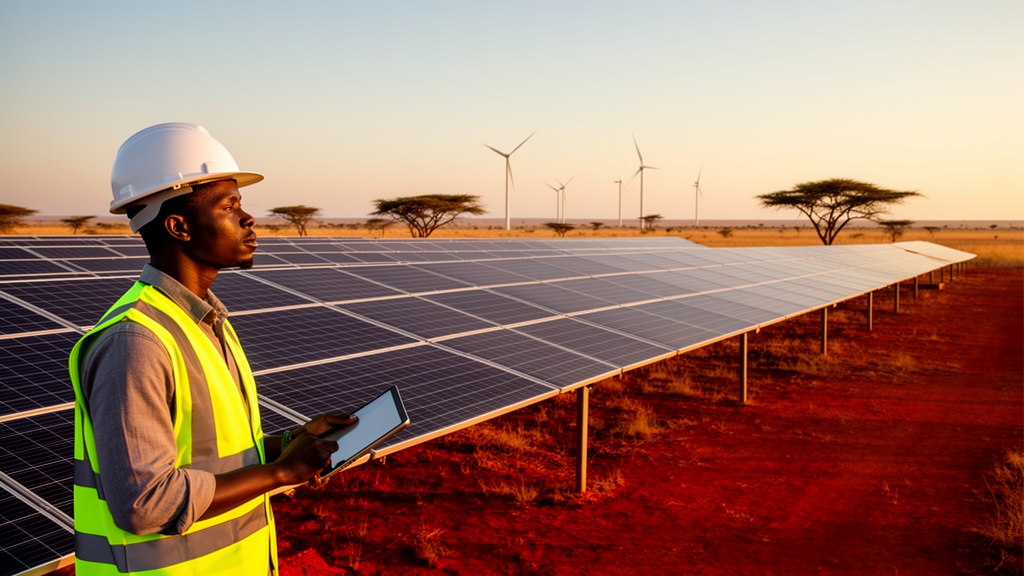
Generative artificial intelligence is being investigated worldwide for forecasting renewable power, optimising grids, predicting equipment failures, generating synthetic data and planning energy infrastructure, but a new systematic review finds that almost none of this evidence has been tested in the field in Africa. The review, published open access in Discover Energy on 12 October 2026, screened records from the OpenAlex database covering 2020 to May 2026 and included 75 studies. Only five of those studies reported an African institutional affiliation, in Morocco, Nigeria and South Africa, with further co-affiliations in Tunisia and Gabon, and none of the five reported validation on an operational African renewable-energy system.
The review was conducted by F. H. Abanda, W. B. Nsanyuy, M. L. Katche and colleagues, and was reported using the PRISMA 2020 guidelines. The authors layered on an AI-assisted workflow called PRALSMA, in which ChatGPT Project and Google NotebookLM supported document comparison, thematic extraction and traceability, while study eligibility and all final interpretations remained under researcher control. The search began with 157 records retrieved on 23 May 2026; after screening, retrieval and full-text eligibility assessment, 75 studies remained. The authors stress that the screening process established relevance, not methodological quality, and that quality, evidence maturity and African transferability were appraised separately.
To grade the evidence, the team applied a five-domain checklist adapted from the Mixed Methods Appraisal Tool logic, scoring clarity of the research question, transparency of data sources, appropriateness of method and comparator, adequacy of validation and uncertainty reporting, and explicit discussion of limitations. Each domain was coded 0, 1 or 2, producing high, moderate or low confidence bands. High-confidence evidence comprised 36 of the 75 studies, or 48 percent, concentrated in empirical and simulation or prototype studies that reported a comparator or baseline and discussed limitations. Moderate-confidence evidence made up 35 studies, or 47 percent, dominated by review and synthesis papers, while low-confidence evidence accounted for 4 studies, or 5 percent, retained only to flag prospective research directions.
Findings were also coded by evidence maturity: E1 for African operational or field validation, E2 for empirical validation outside Africa, E3 for laboratory, simulation or prototype evidence, and E4 for conceptual, review-based or proposed uses. Quantitative results were deliberately not pooled, because outcomes, baselines, datasets and evaluation settings were too heterogeneous. Each application was further assessed for transferability across four dimensions: similarity of energy resource and input data, compatibility with grid architecture and operational scale, availability of computing, connectivity, finance and specialist skills, and alignment with local institutions, regulation, languages and maintenance practices. A numerical outcome was never extrapolated to Africa unless the cited study included comparable African validation.
The bibliometric picture confirms how young and geographically skewed the field is. Most of the included publications appeared between 2023 and 2025, with virtually none between 2020 and 2022, a distribution the authors attribute to the rapid diffusion of foundation models. Authorship is concentrated in Western countries and several Asian economies, with 19 Asian and 19 Western countries represented in the corpus, alongside contributions from developing nations such as Bangladesh and Iraq. The five African-affiliated studies, the authors note, contribute to the corpus’s authorship diversity rather than to its African field-evidence base, and the review keeps those two categories analytically distinct.
Among the demonstrated and emerging applications, forecasting stands out. Several studies reported improved renewable-energy forecasts on their own datasets and baselines, including established non-generative deep-learning forecasters such as hybrid CNN-LSTM and CNN-LSTM-Transformer models. A limited subset reviewed in the corpus reported roughly 15 to 20 percent lower root-mean-square error for selected solar-irradiance tasks and improved spatiotemporal wind simulations, but the review treats these as non-pooled, context-specific results that do not establish a corresponding improvement for African systems. In system optimisation, a modelled photovoltaic-integration case reported energy-cost reductions of up to 20 percent and carbon-emission reductions of 30 percent relative to the study’s own baseline, values that depend on that system’s data, tariffs, grid mix and optimisation assumptions, and for which no African replication was identified.
Synthetic data generation is one of the areas the authors consider most relevant to African conditions, where energy planning is frequently hindered by incomplete datasets, weak monitoring infrastructure and limited modelling capacity. Generative adversarial networks and Wasserstein GANs can impute missing time-series data and support model development when sensors fail; selected non-African studies reported more than 20 percent lower error with up to 40 percent missing observations, though performance was evaluated on particular datasets and missingness patterns. The review insists that African pilots must test whether generated values preserve local seasonal extremes and equipment behaviour, and that synthetic data cannot substitute for minimum ground-truth monitoring. A South African-affiliated study from Durban University of Technology used deep convolutional GANs to generate synthetic datasets for assessing defects in photovoltaic cells.
Other applications sit at earlier stages of maturity. Diffusion and score-based models can generate probabilistic renewable-output scenarios rather than single-point forecasts, but their iterative inference and data requirements make near-term use more plausible in well-instrumented control centres or research pilots than in isolated low-resource mini-grids. Agentic systems that combine telemetry, imagery, weather and maintenance records to flag degradation remain emerging; the review found no African field evaluation supporting a claimed 60 percent maintenance-cost reduction and recommends measuring cost and downtime effects in controlled pilots against current inspection practice. Generative adversarial imitation learning for microgrid dispatch is a research-stage option whose affordability and reliability gains have not been demonstrated in African field deployment. Small language models can run on some edge devices and may provide offline access to manuals, but early renewable-energy benchmarks reported sub-par performance for the tested models and a need for domain adaptation.
The review also weighs the environmental cost of the technology itself. Large-scale generative models consume substantial electricity, often non-renewable, and water during both training and query generation, creating environmental risks that may counteract the sustainability gains achieved in energy efficiency, a rebound effect that challenges the core tenets of Green AI thinking. The authors argue that assessment must cover the full lifecycle, including model development and training, repeated inference and data transfer, data-centre cooling and water, embodied impacts of accelerators and edge devices, and electronic waste. Operational savings cannot automatically be assumed to offset those burdens; a deployment should be described as environmentally beneficial only when avoided energy use or emissions exceed the training, inference, communications, cooling and hardware impacts under the local grid mix, with uncertainty reported. No general 30 to 70 percent energy-saving range was supported as a transferable renewable-energy outcome.
On deployment readiness, the review concludes that bounded small-language-model decision support with retrieval and GAN or VAE data-imputation pilots are more deployment-ready than compute-intensive diffusion models, full digital twins, agentic maintenance or imitation-learning dispatch. Even the higher-ranked applications require local benchmarks, human oversight, offline and fail-safe operation, cybersecurity controls and total-cost assessment covering hardware, power conditioning, cooling, licences, maintenance and staff retention. The authors recommend a staged readiness gate: audit data and sensor quality, verify connectivity and power, establish a multidisciplinary utility-AI-cybersecurity team, run shadow-mode tests, compare technical and economic baselines, validate local languages and extreme conditions, and approve escalation, override and accountability procedures. Deployment should follow an offline-first and fail-safe architecture with deterministic safety constraints, manual fallback and auditable logs.
Strategically, the authors call for Green AI policies that specify energy-efficient hardware and renewable-powered computation, explainable AI frameworks such as Shapley Additive Explanations to make model outputs accountable, integration of GenAI into renewable-energy curricula with safeguards for practical skills, and knowledge transfer that moves beyond traditional North-South hierarchies toward interdisciplinary partnerships. Open-source platforms and tools such as Google Earth Engine could improve access for small enterprises and local utilities, and transfer learning may adapt models developed in data-rich regions to African contexts, reducing local data requirements. Six research priorities are proposed, including lightweight offline-capable models for off-grid operation, explainable decision support co-designed with operators and communities, federated and privacy-preserving learning, Africa-specific renewable-energy datasets, low-cost digital twins for microgrids, and common resource-constrained deployment benchmarks. The review’s central message is that GenAI should be approached as a set of candidate tools rather than a predetermined solution, and that credible progress will come from locally governed data, transparent baselines, staged pilots, lifecycle accounting and independent field validation rather than from transferring unsupported global claims into African policy.
Subject of Research: A systematic review of generative AI applications in renewable energy and their transferability to African energy transitions
Article Title: Global advances in Generative AI for renewable energy and implications for sustainable energy transitions in Africa
Article References: Abanda, F. H., Nsanyuy, W. B., Katche, M. L., Achiri, A. T., Sankey, E. M., Maluh, N. B., & Almukhtar, A. (2026). Global advances in Generative AI for renewable energy and implications for sustainable energy transitions in Africa. Discover Energy, 6(1), Article 82. https://doi.org/10.1007/s43937-026-00195-8
Image Credits: AI Generated
DOI: 10.1007/s43937-026-00195-8
Keywords: generative AI, renewable energy, Africa, systematic review, energy transition, GANs, synthetic data, predictive maintenance, Green AI, energy access, digital twins, small language models