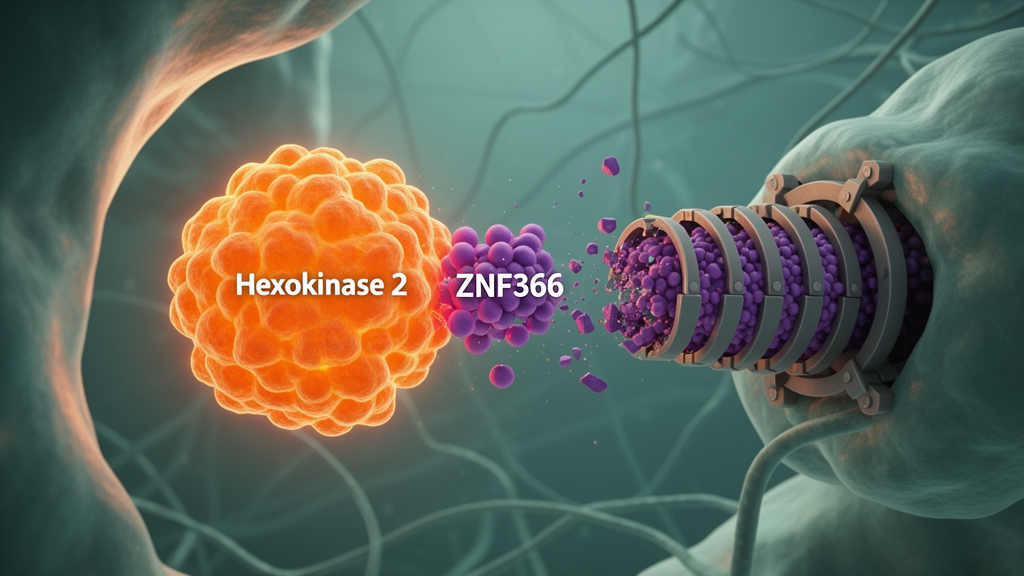
Hexokinase 2 (HK2), long known as a key enzyme of the Warburg effect in cancer metabolism, also appears to promote colorectal cancer through a route that has nothing to do with glycolysis. According to a study published in Biology Direct on 22 October 2026, HK2 facilitates the degradation of the zinc finger protein ZNF366 by recruiting the E3 ubiquitin ligase UBE3A, thereby removing a brake on the malignant behavior of colorectal cancer cells.
The research team set out to identify glycolysis-independent targets of HK2 in colorectal cancer (CRC), a disease in which HK2 has previously been associated with poor prognosis.
ZNF366, it turns out, is downregulated in both colorectal cancer tissues and colorectal cancer cell lines, the study reports. When the researchers forced ZNF366 expression back up in cells, the consequences were consistent with a tumor-suppressive role: cell proliferation, invasion, and migration all declined in vitro, and tumor growth slowed in a xenograft model in vivo. At the molecular level, ZNF366 overexpression was accompanied by decreased levels of pERK1/2, Cyclin D1, and MMP9, proteins linked to signaling, cell-cycle progression, and invasion respectively.
The reverse experiment reinforced the picture. Knocking ZNF366 down increased the expression of those same markers, indicating that ZNF366 normally exerts a negative regulatory influence on malignant phenotypes in CRC cells. In other words, the less ZNF366 a tumor cell carries, the more aggressively it behaves.
A key clue to the connection with HK2 came from patient specimens. In CRC tissue samples, HK2 and ZNF366 protein levels were inversely correlated, suggesting that the metabolic enzyme and the zinc finger protein sit on opposite ends of the same regulatory relationship in human tumors.
Experiments in cells then showed how that relationship works. HK2 reduced ZNF366 protein levels without affecting its mRNA expression, pointing to a post-transcriptional mechanism rather than suppressed gene transcription. The degradation route was traced to ubiquitination: UBE3A was identified as the E3 ubiquitin ligase responsible for tagging ZNF366 for destruction.
The mechanistic model that emerges is a three-part axis. HK2 enhances the interaction between ZNF366 and UBE3A, which increases polyubiquitylation of ZNF366 and speeds its degradation. With ZNF366 cleared away, the constraints it places on proliferation, invasion, and migration are lifted, and the malignancy of CRC cells is enhanced. The authors describe this HK2-UBE3A-ZNF366 axis as a novel regulatory pathway underlying the non-metabolic functions of HK2 in colorectal cancer.
The study’s authors are careful about the strength of the claim. Their conclusion states that HK2-facilitated, UBE3A-dependent ZNF366 degradation “may partially contribute” to the tumor-promoting effect of HK2, framing the new axis as one contributor among likely several rather than a complete explanation of HK2’s oncogenic role.
Methodologically, the findings rest on a standard preclinical toolkit: western blotting and qRT-PCR for expression analysis, functional assays for proliferation, invasion, and migration, co-immunoprecipitation and ubiquitination assays for the mechanism, and a xenograft model for in vivo tumor growth. As with any cell-line and xenograft study, the results demonstrate mechanisms in experimental systems and will require further work to establish clinical relevance in patients.
Still, the study adds a notable entry to a growing list of enzymes with jobs beyond their canonical chemistry. HK2, best known for its role in committing glucose to glycolysis, now appears to act as a scaffold or facilitator in a protein-degradation pathway that shapes tumor behavior. If the HK2-UBE3A-ZNF366 axis holds up in further studies, it may offer researchers a new angle from which to consider the malignant phenotypes of colorectal cancer.
Subject of Research: A non-metabolic role of hexokinase 2 in colorectal cancer via UBE3A-dependent ZNF366 degradation
Article Title: A non-metabolic function of hexokinase 2 in colorectal cancer: HK2 promotes malignant phenotypes by facilitating UBE3A-Dependent ZNF366 degradation
Article References: Jia, Z., Liu, X., Zhao, L., Wang, H., Liu, Y., Liu, S., Jia, M., Heng, B., Fan, J., Liu, Y., Kong, P., & Kong, D. (2026). A non-metabolic function of hexokinase 2 in colorectal cancer: HK2 promotes malignant phenotypes by facilitating UBE3A-Dependent ZNF366 degradation. Biology Direct. https://doi.org/10.1186/s13062-026-01016-7
Image Credits: AI Generated
DOI: 10.1186/s13062-026-01016-7
Keywords: hexokinase 2, HK2, colorectal cancer, ZNF366, UBE3A, ubiquitination, protein degradation, Warburg effect, tumor suppressor, xenograft model, non-metabolic function, Biology Direct