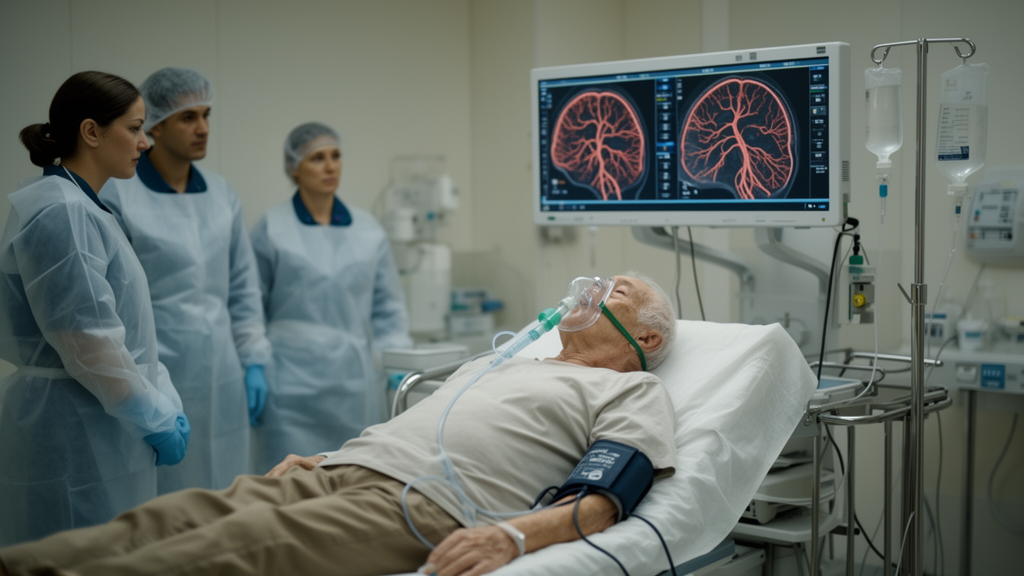
Acute ischemic stroke remains a leading cause of death and long-term disability worldwide, and in patients with large vessel occlusion (LVO), endovascular thrombectomy (EVT) has transformed care by achieving high rates of vessel recanalization. Yet a recurring puzzle shadows this technical success: restoring blood flow through a blocked artery does not guarantee a good neurologic outcome. A new Commentary published in Anesthesiology and Perioperative Science argues that the missing piece may lie in periprocedural physiology, specifically in how oxygenation and perfusion are managed in the hours surrounding the procedure. Its central claim is that these two variables should be considered together, and that the physiologic targets appropriate for patients with LVO may differ from those derived from broader acute ischemic stroke populations.
The biological rationale rests on the ischemic penumbra, the hypo-perfused but still viable brain tissue that surrounds the infarct core in many LVO patients. This tissue depends on collateral circulation, the secondary vascular routes that sustain blood supply when a major artery is occluded. Because collateral flow is fragile, early physiologic disturbances may accelerate the progression of penumbral tissue to frank infarction and worsen outcomes. The anesthesia team, which is primarily responsible for managing oxygenation, ventilation, and hemodynamic stability during thrombectomy, is therefore uniquely positioned to influence the key determinants of cerebral perfusion and tissue viability. Observational work has shown that early oxygenation levels are independently associated with mortality in acute ischemic stroke, underscoring the importance of this window in the hyperacute phase. Identifying modifiable intraoperative physiologic targets, the authors contend, may offer opportunities to improve outcomes beyond the technical success of reperfusion itself.
A key concept in the Commentary is that physiologic interventions are unlikely to matter equally for every patient. Salvageable penumbra is commonly identified with computed tomography perfusion or magnetic resonance diffusion-perfusion mismatch techniques: a small infarct core combined with a larger hypo-perfused region suggests tissue at risk that may recover with reperfusion. Although specific thresholds vary between studies and software platforms, such a mismatch generally indicates salvageable brain tissue and may identify the patients most likely to benefit from adjunctive physiologic strategies. However, imaging-based selection remains constrained in practice by stroke workflow pressures, variability among post-processing platforms, and reduced availability in some hyperacute clinical settings, limitations that complicate any attempt to tailor therapy to tissue status in real time.
On the oxygenation side, the authors frame cerebral oxygen delivery as the product of arterial oxygen content and cerebral blood flow. In LVO, reduced perfusion increases reliance on collateral flow, leaving the penumbra particularly vulnerable to swings in oxygenation. Oxygenation during and after thrombectomy, they argue, is better understood as a determinant of tissue viability than as a systemic parameter to be normalized. The practical difficulty is that the variable of real interest, oxygen delivery to the penumbra, cannot be measured directly at the bedside; the parameters readily available during the procedure are only indirect surrogates for it.
Even the monitoring tools in common use have blind spots. Pulse oximetry, the standard measure of arterial oxygen saturation, may not reflect regional cerebral oxygen delivery. Atelectasis from supine positioning, ventilation-perfusion mismatch during sedation, and potential respiratory compromise during the procedure can impair cerebral oxygenation even while peripheral saturation readings look normal. Near-infrared spectroscopy offers continuous, noninvasive monitoring of frontal cerebral oxygen saturation and may detect evolving imbalances between oxygen delivery and consumption. But the evidence supporting this approach during endovascular stroke therapy remains limited and inconclusive, and practical constraints, including interference with fluoroscopic imaging and endovascular access from probe placement, may restrict its feasibility during intervention. The authors therefore regard cerebral oximetry as a potentially useful trend monitor rather than a validated physiologic target.
Current guidelines recommend maintaining normoxia while avoiding routine supplemental oxygen in nonhypoxic patients, a position backed by randomized experience showing no benefit from prophylactic oxygen therapy in unselected stroke populations. More recent work, however, has revisited oxygen therapy in a narrower population. In the OPENS-2 trial, normobaric hyperoxia administered across the peri-reperfusion period improved functional outcomes in patients with anterior circulation LVO undergoing EVT, without increasing mortality or serious adverse events. This targeted approach echoes concepts from perioperative oxygen therapy, in which both insufficient and excessive oxygen delivery are recognized as potentially harmful. Importantly, the trial demonstrated benefit in a selected population, and whether treatment effects extend to patients with perfusion-defined salvageable penumbra, successful reperfusion, or other imaging-defined subgroups remains uncertain. Advanced perfusion imaging may ultimately help identify who benefits most from adjunctive oxygen, but that selection strategy requires prospective validation.
Caution also extends to who was not well represented in the evidence. The generalizability of available findings to patients with severe chronic pulmonary disease, large established infarct cores, poor collateral circulation, intracranial hemorrhage, or prolonged procedures remains uncertain, because these populations were underrepresented in published studies and may experience harm from normobaric hyperoxia. Excess oxygen exposure may increase oxidative stress, provoke cerebral vasoconstriction, and impair microvascular perfusion. Current guidance accordingly describes the hyperoxia results in thrombectomy patients as promising while noting that they need replication in larger and more diverse populations before routine adoption.
The perfusion half of the argument concerns blood pressure. Maintaining adequate systemic perfusion before and after recanalization remains central in LVO stroke, but the authors stress that current guideline recommendations on blood pressure control after reperfusion therapies, designed to mitigate hemorrhagic complications, were not intended to define a universally optimal physiologic target. Recent randomized data have raised concerns that indiscriminate intensive blood pressure reduction after EVT may inadvertently compromise perfusion to vulnerable brain tissue, even when recanalization is successful. Taken together, the emerging literature argues less for any single pressure target than for abandoning a one-size-fits-all strategy in favor of individualized hemodynamic management guided by the extent of reperfusion and the likelihood of ongoing ischemic vulnerability.
Hemodynamic stability itself emerges as a recurring theme. Across all phases of care, hypotension is consistently associated with worse outcomes, and even very brief periods of reduced blood pressure can compromise collateral perfusion and produce ischemic injury. Blood pressure variability has similarly emerged as a predictor of outcome after acute ischemic stroke, suggesting that hemodynamic stability may carry prognostic information beyond mean blood pressure alone. In collateral-dependent tissue, the authors suggest, instability is plausibly a mediator of injury rather than merely a marker of stroke severity, although whether variability itself is modifiable remains unproven. Anesthetic management adds further complexity: both general anesthesia and monitored sedation can be appropriate, provided physiologic stability is maintained, and prior work emphasizes that the choice of technique matters less than stable oxygenation and hemodynamics. Careful titration of anesthetic depth, avoidance of respiratory compromise during sedation, and prevention of blood pressure fluctuations are, in the authors’ view, the elements of anesthetic care most likely to influence tissue outcome.
The Commentary’s concluding message is that oxygenation and perfusion should not be treated as independent therapeutic domains. Oxygen delivery to ischemic tissue depends on both arterial oxygen content and cerebral blood flow, so even optimized oxygen content cannot reach penumbral tissue if cerebral perfusion pressure is inadequate, while hyperoxia-induced cerebral vasoconstriction may reduce microvascular perfusion and partially offset gains in oxygen content. This coupling may be especially important in LVO patients with impaired autoregulation and collateral-dependent circulation, in whom hypotension can compromise oxygen delivery despite apparently adequate systemic oxygenation. The authors are candid about the limits of current knowledge: the patients in whom normobaric hyperoxia helps, and those in whom it may harm, are incompletely defined; optimal timing and duration of oxygen administration are unknown; cerebral oximetry has not been validated as an intervention target during EVT; and the interaction between physiologic optimization and reperfusion quality has not been examined directly. They call for prospective evaluation of imaging-based selection for adjunctive physiologic therapy, trial designs capable of testing individualized rather than fixed targets, multimodal physiologic monitoring during thrombectomy, and implementation research on delivering such strategies within hyperacute stroke workflows, with oxygenation and perfusion evaluated as interacting therapeutic determinants rather than isolated targets.
Subject of Research: Periprocedural oxygenation and perfusion management in large vessel occlusion stroke undergoing endovascular thrombectomy
Article Title: Oxygenation and perfusion in large vessel occlusion stroke: rethinking periprocedural management in the endovascular era
Article References: Akça, O., & Gomez, J. (2026). Oxygenation and perfusion in large vessel occlusion stroke: rethinking periprocedural management in the endovascular era. Anesthesiology and Perioperative Science, 4(1), Article 46. https://doi.org/10.1007/s44254-026-00194-x
Image Credits: AI Generated
DOI: 10.1007/s44254-026-00194-x
Keywords: large vessel occlusion, endovascular thrombectomy, ischemic penumbra, oxygenation, normobaric hyperoxia, cerebral oximetry, blood pressure management, anesthesia, collateral circulation, acute ischemic stroke, reperfusion, hemodynamic stability