
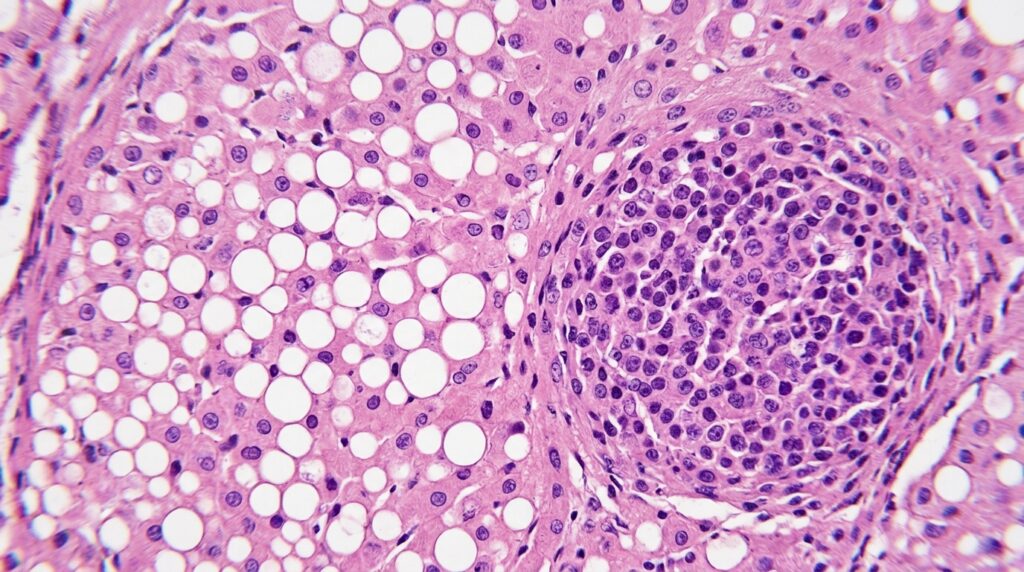
Investigating the metabolic disruptions that drive liver cancer, researchers have uncovered how hyperactivation of the Ras and ERK signaling cascade suppresses sterol 12alpha-hydroxylase, an essential enzyme encoded by the CYP8B1 gene, leading to severe cholesterol accumulation, depleted bile acids, and accelerated hepatic tumorigenesis. The liver serves as the central metabolic hub governing the delicate balance between cholesterol and bile acids, converting excess cholesterol into bile acids to maintain cellular homeostasis and clear lipids from hepatocyte membranes. However, in hepatocellular carcinoma, this equilibrium is frequently disrupted. Publishing in Cancer and Metabolism, a research team demonstrated that oncogenic signaling systematically represses CYP8B1 expression, reducing bile acid biosynthesis and leading to cholesterol accumulation in hepatic tissue, which facilitates tumor progression.
To establish the clinical relevance of this metabolic alteration in human patients, the investigators initially interrogated multi-omic datasets from The Cancer Genome Atlas alongside eighteen paired surgical specimens of human hepatocellular carcinoma and adjacent non-tumor liver tissues. Among the primary rate-limiting enzymes coordinating cholesterol catabolism and bile acid synthesis, only CYP8B1 exhibited significant downregulation in cancerous liver tissue compared to non-malignant controls. Furthermore, high expression of CYP8B1 was positively correlated with prolonged overall patient survival, whereas elevated levels of Hras and ERK transcripts showed an inverse relationship with CYP8B1 abundance and poor clinical outcomes. In patient biopsy samples, elevated phosphorylated ERK occurred in 44.4 percent of cases, while diminished CYP8B1 protein was detected in 77.8 percent of specimens. Concomitant ERK hyperactivation and CYP8B1 repression manifested in 33.3 percent of the analyzed cohort, with consistent reductions across both mRNA and protein levels validated in 38.9 percent of samples.
Complementary serological evaluations in clinical cohorts underscored how systemic cholesterol dynamics track the clinical stages of liver disease. Circulating total cholesterol concentrations in individuals with underlying liver cirrhosis rose significantly following malignant transformation into frank hepatocellular carcinoma. Furthermore, patients presenting with large hepatic tumors exhibited significantly higher serum cholesterol levels than those diagnosed with smaller lesions, while surgical resection of the primary neoplasm elicited a prompt, significant reduction in circulating cholesterol content. In vitro evaluations across established human hepatocellular carcinoma cell lines corroborated these human tissue observations. With the sole exception of the HepG2 line, every evaluated malignant liver cell line exhibited pronounced elevation of phosphorylated ERK alongside marked downregulation of CYP8B1 protein. Pharmacological blockade of ERK using the small-molecule inhibitor PD184352 at four micromolar for forty-eight hours in MHCC97H hepatoma cells restored both CYP8B1 protein expression and its enzymatic catalytic output, directly measured by the conversion of substrate to 7alpha,12alpha-hydroxy-4-cholestene-3-one.
To dissect the physiological mechanisms driving this metabolic disturbance in an intact mammalian system, the researchers deployed an established transgenic mouse model designated Ras-Tg, which expresses the oncogenic human Hras12V variant specifically in hepatocytes under the control of an Albumin enhancer and promoter. These transgenic mice faithfully recapitulate human pathology by developing hepatic lesions across three distinct chronological stages: nodular tumorigenesis with lesions under two millimeters, adenomatous initial development with diameters between two and five millimeters, and malignant carcinoma progression defined by tumors exceeding five millimeters. At five months of age, male Ras-Tg animals presented primarily with early nodules and adenomas, exhibiting modest elevations in the liver-to-body weight ratio relative to wild-type controls. By eight months of age, the transgenic animals harbored multiple massive carcinomas and adenomas, accompanied by marked hepatomegaly that produced dramatic increases in liver weight and organ-to-body ratios alongside progressive elevations in Hras12V transcript and phosphorylated ERK abundance.
Quantification of tissue sterol levels revealed marked cholesterol accumulation throughout the hepatic compartment of Ras-Tg mice. Both peri-tumoral tissue and distinct tumor nodules displayed sharp increases in total cholesterol content from five to eight months of age compared to non-transgenic littermates. Strikingly, despite the severity of the malignant transformation, eight-month-old tumor tissues consistently contained significantly lower concentrations of cholesterol than adjacent peri-tumoral parenchyma, a finding corroborated by fluorescent lipid staining of cryo-sectioned hepatic tissue. Serum total cholesterol was also substantially elevated in both five-month and eight-month transgenic cohorts relative to wild-type animals. Next-generation sequencing and quantitative real-time polymerase chain reaction confirmed that Cyp8b1 transcript levels fell significantly in both peri-tumoral and tumor tissues at eight months, accompanied by identical declines in protein expression and microsome enzyme activity. Consequently, total bile acid concentrations decreased in liver tissue and gallbladder bile, with primary bile acid depletion in older transgenic animals driven by steep reductions in cholic acid and its conjugated derivatives rather than beta-muricholic acid. No change was detected in the serum of eight-month-old transgenic mice.
To definitively assess whether active ERK signaling drives the suppression of CYP8B1 and subsequent bile acid depletion in vivo, eight-month-old Ras-Tg mice were treated with the targeted p-ERK inhibitor AZD6244 administered intragastrically at one hundred milligrams per kilogram twice daily for seven consecutive days. Pharmacological suppression of phosphorylated ERK robustly elevated CYP8B1 protein abundance and restored catalytic activity in both peri-tumoral and malignant liver tissues. This enzymatic recovery triggered a notable resurgence in cholic acid and associated primary bile acid production, which depleted accumulated cholesterol stores across peri-tumoral tissue, tumor masses, circulation, and the gallbladder. Histological examination and terminal deoxynucleotidyl transferase dUTP nick end labeling staining confirmed that seven days of ERK inhibition substantially decreased the liver-to-body weight ratio and induced widespread apoptotic death within tumor lesions without altering Hras12V transgene expression or baseline tumor multiplicity, establishing a functional causal chain connecting pathway signaling to metabolic remodeling.
Mechanistic probing demonstrated that the transcription factor sterol regulatory element binding protein 2, or SREBP2, functions as the crucial molecular intermediary bridging oncogenic ERK activation with CYP8B1 transcriptional shutdown. Transgenic mice exhibited elevated levels of both the cytoplasmic precursor and nuclear mature forms of SREBP2 in diseased liver tissue. Treatment with AZD6244 selectively suppressed the nuclear accumulation of mature SREBP2 without diminishing its cytoplasmic precursor pool. To confirm the necessity of this mediator, eight-month-old Ras-Tg animals received intraperitoneal injections of the SREBP inhibitor fatostatin at thirty milligrams per kilogram once daily for fourteen days. SREBP inhibition mirrored the benefits of direct ERK blockade, reducing nuclear mature SREBP2, rescuing CYP8B1 expression and enzymatic activity, and normalizing systemic cholesterol and bile acid profiles. The authors propose that in the context of constitutive Ras/ERK activation, hyperactivated SREBP2 competes with the HNF4alpha and PGC-1alpha transcriptional complex to inhibit CYP8B1 transcription, establishing a direct molecular link from oncogenic Ras/ERK signaling to metabolic reprogramming in HCC.
The paradoxical observation that advanced tumor tissues contained significantly lower cholesterol concentrations than adjacent peri-tumoral liver tissue led researchers to evaluate the expression of apolipoproteins and lipid transport machinery. Serum analysis revealed that eight-month transgenic mice possessed elevated cholesterol within both high-density lipoprotein and low-density lipoprotein fractions. Interestingly, while circulating levels of the high-density lipoprotein component APOA1 were significantly increased in transgenic mice, serum levels of the low-density lipoprotein component APOB remained unchanged. However, within hepatic tissues, both APOA1 and APOB transcripts and protein products exhibited dramatic upregulation, rising from peri-tumoral parenchyma to peak inside tumor lesions. Concurrently, expression of the sinusoidal bile acid uptake transporter Slc10a1 decreased while the canalicular efflux transporter Abcc2 increased in tumor nodules. This concerted upregulation of apolipoprotein efflux machinery suggested that malignant hepatocytes actively export cholesterol into systemic circulation to shield themselves from intracellular sterol overload and lethal free cholesterol lipotoxicity.
To challenge the defensive capacity of this lipid export system, the investigators placed four-month-old Ras-Tg mice on an experimental high-cholesterol diet consisting of one percent cholesterol and 0.5 percent sodium cholate for three months. Rather than accelerating tumor growth, excessive dietary cholesterol significantly curbed malignant progression without impacting initial tumorigenesis. Consequently, total liver weight and liver-to-body weight ratios dropped substantially in the high-cholesterol cohort. Parallel gavage experiments using pure cholesterol confirmed that this protective effect occurred independently of sodium cholate and did not stem from altered expression of albumin, Hras12V, or phosphorylated ERK, demonstrating that intense cholesterol overload exerts selective toxicity against advanced neoplastic cells.
Molecular profiling revealed that excess dietary cholesterol triggered profound pathway-specific disturbances across the liver. In peri-tumoral tissue, cholesterol overload upregulated phosphorylated mTOR and nuclear factor kappa B while simultaneously increasing pro-survival BCL2 and pro-apoptotic BAX. Within tumor tissue, however, excess cholesterol failed to stimulate mTOR or NF-kB but induced dramatic activation of glycogen synthase kinase 3 beta, beta-catenin, and cleaved caspase-3, alongside substantial downregulation of both BCL2 and BAX. These discordant responses indicate that while peri-tumoral parenchyma balances survival and death signals, malignant cells suffer catastrophic endoplasmic reticulum stress, oxidative injury, and apoptotic signaling once dietary sterols overwhelm their apolipoprotein-mediated efflux defenses.
Notwithstanding these robust phenotypic and pharmacological discoveries, the authors outlined key technical boundaries and unresolved questions that warrant targeted future study. Although reciprocal correlations and pharmacological rescues using AZD6244 and fatostatin establish a clear functional axis connecting Ras, ERK, SREBP2, and CYP8B1, definitive genetic verification will require hepatocyte-specific Cyp8b1 knockout and overexpression mouse models to demonstrate whether enzyme loss alone is fully sufficient to recapitulate the complete metabolic syndrome. Furthermore, the authors note that SREBP2 does not seem to bind the Cyp8b1 promoter directly, implying that the regulation involves indirect metabolic or transcriptional mechanisms that remain to be clarified. Distinguishing tumor cell-autonomous mechanisms from broader tissue-level effects also necessitates further in vitro experiments, including cholesterol manipulation and detection of cell viability, apoptosis, and ERK activity. Nevertheless, these findings demonstrate that oncogenic ERK signaling exploits SREBP2 to throttle CYP8B1-mediated bile acid synthesis, unveiling a biphasic cholesterol dynamic that offers actionable metabolic targets for liver cancer therapy.
Subject of Research: Ras and ERK pathway regulation of CYP8B1 enzyme activity, cholesterol accumulation, and bile acid homeostasis in hepatocellular carcinoma
Article Title: CYP8B1 suppressed by Ras/ERK leads to cholesterol accumulation and bile acids reduction and facilitates hepatic tumorigenesis
Article References: Li, J., Li, H., Dong, L., Yao, L., Dong, X., Guo, Y., Pu, C., Wang, A., & Chen, J. (2026). CYP8B1 suppressed by Ras/ERK leads to cholesterol accumulation and bile acids reduction and facilitates hepatic tumorigenesis. Cancer & Metabolism, 14(1), Article 24. https://doi.org/10.1186/s40170-026-00439-0
Image Credits: AI Generated
DOI: 10.1186/s40170-026-00439-0
Keywords: CYP8B1, hepatocellular carcinoma, Ras/ERK signaling, cholesterol homeostasis, bile acids, SREBP2, taurodeoxycholic acid, hepatic tumorigenesis, suppressed, leads, cholesterol, accumulation